The numbers
Salt is a remarkably sensitive variable.
Ten different implementations of the same hypothesis. A swing of ~364 TW in the global heat transport response — and the sign of the rainfall effect over the Amazon itself flips between polluted and pristine baselines. At the Pöhlker-observed particle size, the local Amazon enhancement is preserved while far-field signals are modest — consistent with evolution selecting for local rainfall, not global climate.
| Metric | v7 Autoconv | v8 Twomey | GCCN Simp. | GCCN (buggy) | Bug-fixApril 2026240 km mesh · 30-day
v8.3.1 GCCN · NH summer | Bug-fixJanuary 2025120 km mesh · 30-day
v8.3.1 GCCN · NH winter | Phase 7 · PöhlkerPolluted4,400 → 8,800 /cm³
80 nm · κ=0.4
ngccn=0 | Phase 7 · PöhlkerPristine150 → 300 /cm³
80 nm · κ=0.4
ngccn=0 | Phase 7 · Pöhlker-matchedPristine + Dg150 → 300 /cm³
160 nm · κ=0.8
Matches Pöhlker Dg=150 nm | Phase 7 · sensitivityPristine + upper-bound150 → 300 /cm³
320 nm · κ=0.8
Upper-bound size test |
|---|
| Equatorial rain (band avg) | −0.10 | +0.05 | +0.19 | +0.05 | +0.17 mm/day | −0.002 mm/day | −0.13 mm/day | −0.09 mm/day | +0.15 mm/day | −0.03 mm/day |
| Rain at 5°S zonal | n/a | n/a | n/a | n/a | +0.62 | −0.21 | −0.28 | −0.25 | +0.47 | −0.08 |
| Rain at 5°N zonal | n/a | n/a | n/a | n/a | −0.31 | +0.18 | −0.62 | +0.50 | +0.24 | +0.21 |
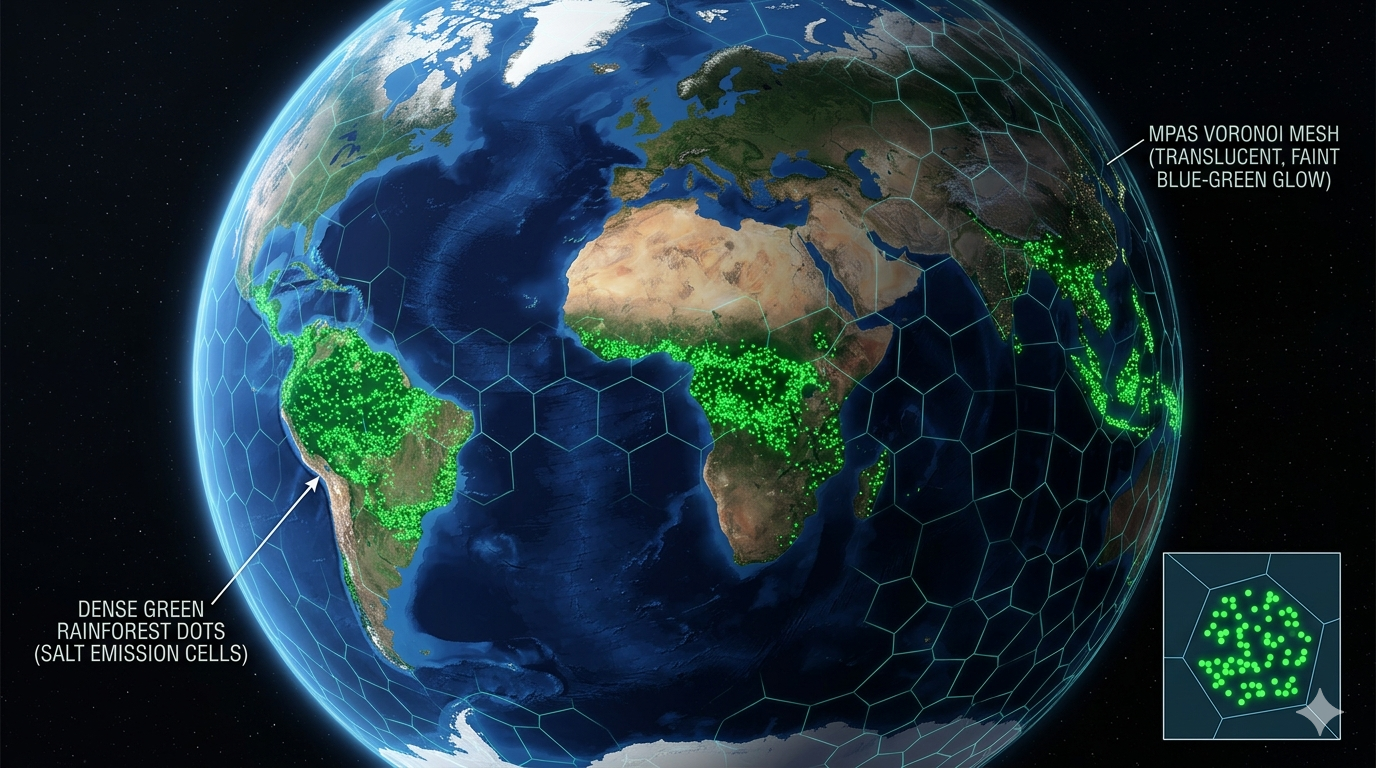
Rain over Amazon rainforest
(SALT − NOSALT, 30-day total, averaged over evergreen broadleaf forest cells only) | n/a | n/a | n/a | n/a | +0.5 mm | +6.9 mm | −17.1 mm | +5.6 mm | +5.4 mm | −3.0 mm |
| 30°N transport | −153 | +66 | +42 | −95 | +153 TW | −211 TW | −109 TW | −172 TW | +31 TW | +136 TW |
| 30°S transport | n/a | −330 | n/a | −18 | −61 TW | +71 TW | +210 TW | +15 TW | −125 TW | −249 TW |
| Arctic temp | −0.15 | +0.32 | +0.21 | +0.43 | +0.14 K | +0.88 K | +1.73 K | +0.86 K | +0.12 K | +0.24 K |
| Arctic 10m wind | n/a | n/a | n/a | n/a | +0.00 m/s | +0.38 m/s | −0.20 m/s | −0.16 m/s | +0.12 m/s | +0.45 m/s |
| Antarctic temp | +1.5 | −0.50 | −0.13 | −1.03 | −1.26 K | +0.04 K | 0.00 K | +0.03 K | +0.03 K | +0.12 K |
Reading the table. Columns are grouped by mechanism. Columns 1–4 (grey): earlier implementations with known limitations. Columns 5–6 (green): the two “Bug-fix” runs that modeled K-salt as giant CCN (200 nm collision-coalescence, ngccn active) — April and January seasonal mirrors. Columns 7–10 (blue): four Pöhlker Phase 7 runs that model K-salt as accumulation-mode CCN through the nwfa field, with ngccn explicitly disabled. The column with the blue accent bar (column 9, “Pristine + Dg”) is the primary Pöhlker-matched configuration: 160 nm diameter, closest to Pöhlker’s reported accumulation-mode geometric mean diameter Dg = 150 nm. Column 10 (“Upper-bound”, 320 nm) is a sensitivity test rather than a Pöhlker-matched configuration.
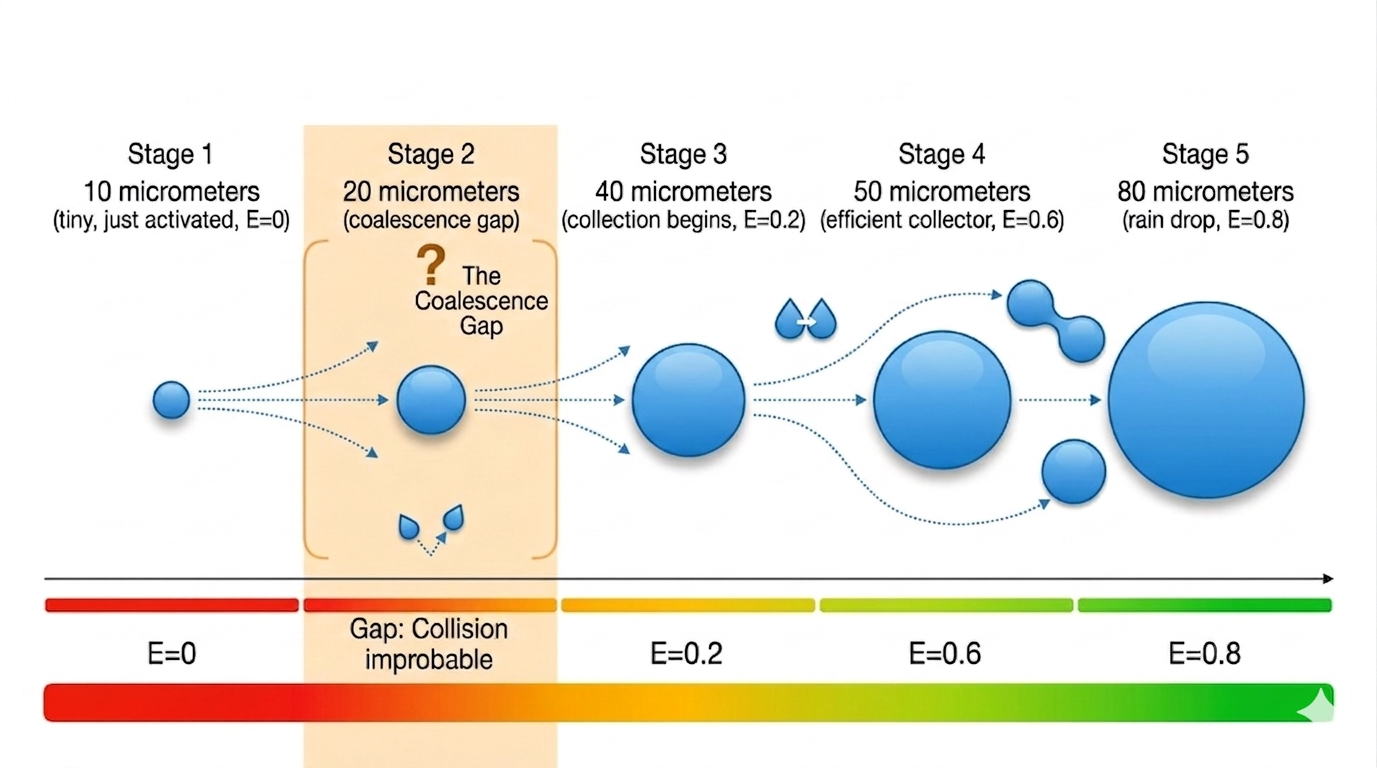
The central sign-flip finding (columns 7–10). Starting from MPAS’s default polluted Amazon baseline (~4,400 nwfa/cm³, representative of modern Amazon air influenced by anthropogenic sources), adding K-salt suppresses local rainfall by 17.1 mm over 30 days — the air is already past its precipitation-efficient CCN concentration. Lowering the baseline to match Pöhlker’s direct clean-air observations (~150/cm³) and adding the same fractional K-salt contribution enhances Amazon rainfall by 5.4–5.6 mm (the sign-flip is robust to the activation-size choice). The sign of the rainforest’s self-watering response flips with the background pollution level. The upper-bound sensitivity (column 10, 320 nm) reverts the effect toward zero, consistent with the system being pushed past its precipitation optimum when the assumed particle size is too large relative to the observed Dg. The response depends on effective CCN activation capacity (number × size × hygroscopicity), not raw particle number alone.
At Pöhlker’s observed particle size (column 9), global circulation responses are modest. 30°N transport changes by only +31 TW (vs. −172 at default size and +136 at upper-bound), and Arctic temperature changes by +0.12 K — near the noise floor of single-realization runs. This is scientifically important: plants and fungi in the rainforest cannot plausibly have been selected by evolution for effects at the poles. Atmospheric transport timescales from the Amazon to the Arctic are too slow (months to years) for any polar consequence to feed back on individual-organism fitness. The observed K-salt size should therefore be expected to optimize for local rainfall with modest far-field consequences — which is exactly what column 9 shows. The larger transport signals in the other columns appear to be artifacts of size assumptions that do not match the observed biological emission.
Arctic wind still responds physically at the polluted and pristine baselines. Surface wind speed over the Arctic core (beyond 70°N) decreases with K-salt addition at both the polluted (−0.20 m/s) and pristine-default (−0.16 m/s) configurations. Since polar ice loss is dominated by convective heat transport (turbulent sensible heat flux, proportional to wind speed) rather than conductive warming from air temperature, a 3% wind reduction translates to ~1–2 W/m² reduction in heat delivery to sea ice — within the magnitude range of regional radiative perturbations of climatic interest. At the Pöhlker-matched size (column 9), Arctic wind response is smaller (+0.12 m/s), consistent with the view that the observed biology-selected size produces clean local effects with muted far-field consequences.
Columns 5–6 still show the seasonal-mirror pattern. For the GCCN bug-fixed April/January pair: rain direction, 30°N transport, 30°S transport, and Antarctic temperature all flip sign with the season — consistent with salt modulating whichever Hadley branch is currently active. Arctic temperature warms in both seasons.
The 30°N transport numbers range from −211 TW to +153 TW across ten implementations of the same salt hypothesis, with mean ~−31 TW and standard deviation ~126 TW — larger than the entire estimated effect of anthropogenic CO2 on poleward heat transport. Changing a single drop-radius constant from 10 µm to 25 µm flips sign. Changing the baseline CCN concentration from 4,400/cm³ to 150/cm³ changes magnitude and sign. Changing the aerosol size assumption across the Pöhlker-matched lookup options (160 nm vs 320 nm diameter) reverses direction again.
This is not noise. Each run is deterministic on the same initial conditions. The spread is the fingerprint of how strongly biogenic salt couples to the atmospheric circulation. The interpretation we favor: salt functions as a variance amplifier, not a monotonic forcing. Some weather regimes get large latent-heat pulses from GCCN-enhanced rain; others don't. The mean may be near zero. The amplitude of the fluctuations may be large. Testing this requires running paired ensembles — next up.
Within the most physically complete April 240 km bug-fixed configuration, three robust findings emerge: (1) salt redistributes equatorial rain southward — zonal-mean rainfall rises by +0.62 mm/day at 5°S and falls by −0.31 mm/day at 5°N, consistent with salt precipitating moisture on the winter-ward side of the equator before it can cross northward; (2) Antarctica cools by −1.26 K in the hemisphere entering its winter season; (3) southward moisture transport at 30°S is reduced by −61 TW. The Northern Hemisphere 30°N transport (+153 TW) is opposite in sign and is most likely an artifact of the convective parameterization at 240 km.
The January 120 km bug-fixed run partially confirms the seasonal mirror. Rain redistributes northward (+0.18 mm/day at 5°N, −0.21 at 5°S, opposite of April). 30°N transport is reduced by −211 TW (mirror of the April summer-hemisphere increase), 30°S transport is increased by +71 TW. Antarctic temperature is near-neutral at +0.04 K (SH now in summer), consistent with the framework. The unresolved puzzle: the Arctic warms by +0.88 K in January despite reduced moisture transport, pointing to either a dry-heat pathway or weather noise dominating a single-realization experiment.
We make no claim about specific directions or magnitudes here — single realizations cannot distinguish forced signal from weather noise. The community must help us test this properly with ensembles, convection-permitting resolution, and longer integrations.
−17 → +5 mm
Amazon rainfall sign flips with baseline CCN: polluted → suppression, pristine → enhancement (Phase 7)
±150 TW
Spread of 30°N transport response across implementations
−1.26 K
Antarctic cooling with salt (April 240km bug-fixed)
+0.62
mm/day
Rain rise at 5°S; falls by −0.31 mm/day at 5°N. Salt shifts equatorial rain toward the winter hemisphere.

.png)